
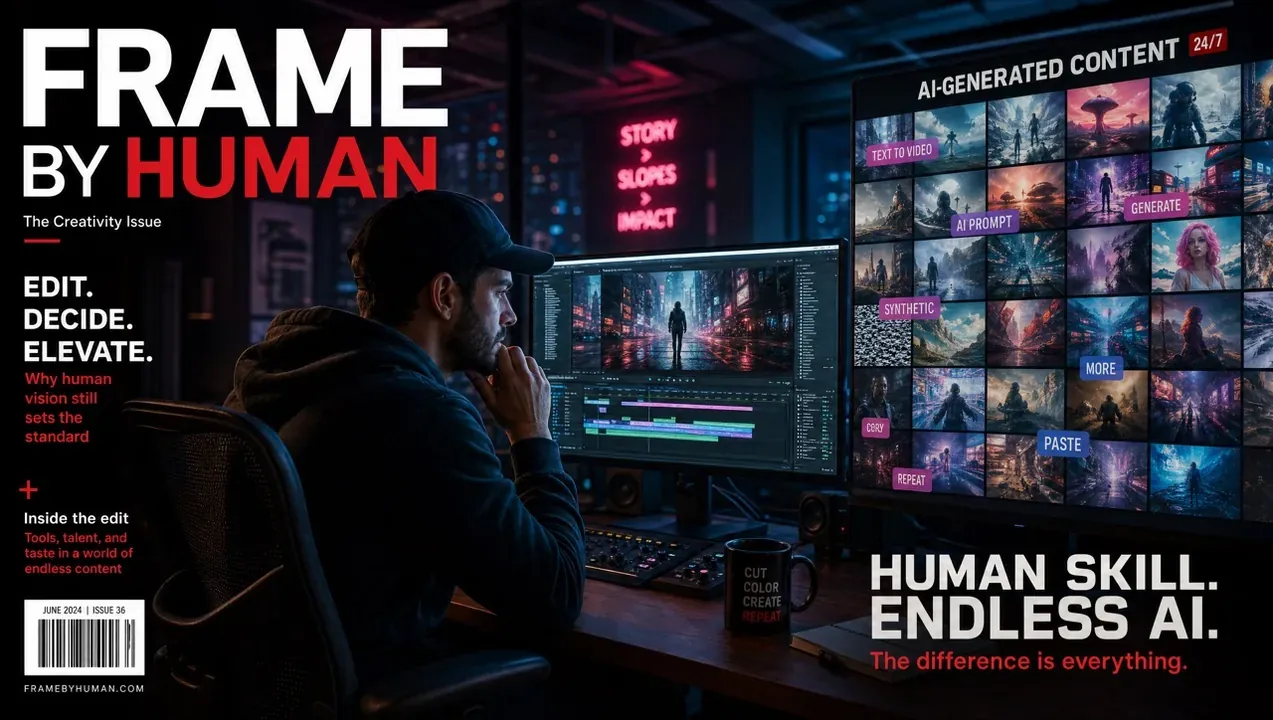
The Moment AI Video Stopped Being Silent
For the past two years, the AI video conversation has been obsessed with one question: does it look real? Sora, Runway, Kling, Luma — everyone was chasing photorealism. Then Google dropped Veo 3 at I/O 2025 and quietly changed the question entirely.
Veo 3 generates synchronised audio natively. Not in post. Not with a separate model stitched on top. The same prompt that builds your video also builds ambient sound, dialogue, sound effects — and, critically, music-adjacent audio beds. The model hears what it sees.
That sounds like a fun demo. It's actually a structural shift in how AI content gets made — and most Indian production studios haven't processed what it means yet.
---
Why Audio Changes Everything (Not Just Convenience)
Here's the thing most people miss: silence was the single biggest tell that an AI video was AI. You could paper over shaky hands, weird physics, and uncanny skin with good colour grading. But the moment a video cut to silence or slapped on a random stock track, the illusion collapsed.
Native audio fixes the weakest link. It means:
- Brand spot mockups that actually sound like a TVC, not a muted animatic
- Concept reels for music labels that carry a temp-track vibe from frame one
- AI UGC content where the ambient world — the café hum, the street noise, the product fizz — exists without a sound designer touching it
- Faster client approvals, because stakeholders respond emotionally to sound in a way they never do to silent footage
For studios like ours that already produce AI music videos and AI-powered commercials, this isn't a threat. It's leverage.
---
The Gap Nobody Is Advertising
Let's be honest about what Veo 3 cannot do — because this is where the real creative opportunity sits.
Audio-native AI video is powerful raw material. It is not, by itself, a finished product. The gap between a Veo 3 output and a deliverable that represents a brand or artist is still enormous — and that gap is called creative direction.
Veo 3 gives you a world. It does not give you:
- A concept that maps to an artist's identity or a brand's positioning
- Shot language — the intentional grammar of cuts, camera movement, and pacing that tells a story
- Colour decisions that feel consistent with a visual identity, not just "cinematic"
- Editorial instinct — knowing which 4 seconds of a 12-second generation are worth keeping
- Legal-ready output — cleared and production-safe for label or brand use
The studios that will win in 2026 are not the ones who have the best prompt engineering. They're the ones who can take AI output and direct it — shaping it into something that earns an emotional response.
---
What This Actually Looks Like in Production
Here's a simplified version of how audio-native AI generation changes a real music video workflow:
Old AI music video pipeline (pre-Veo 3):
- Generate video clips from an image or early video model
- Edit to the music track externally
- Add sound design separately — foley, ambient, SFX
- Colour grade
- Deliver
New pipeline with audio-native generation:
- Generate video + ambient audio from a single, directed prompt
- Select and arrange the best generations to the music track
- Layer generated ambient audio under the music (or discard — your choice)
- Colour grade with intent
- Deliver
The sound design step — which used to consume hours on a short-form video — becomes a curation exercise instead of a build-from-zero task. That time compression compounds fast. For music labels briefing an album rollout with four to six visual pieces, the difference is days, not weeks.
---
The Indian Market Angle
India's music industry is one of the most video-hungry markets in the world. Independent labels, regional artists, and Bollywood-adjacent productions all need visual content at a pace and price point that traditional video production cannot sustainably service.
AI video — and specifically audio-native AI video — does not replace that creative need. It democratises production capacity for smaller artists while giving premium studios a way to deliver more, faster, without dropping the quality bar.
The studios that move first will own the positioning. The ones waiting for AI to "mature" will be explaining a slower, more expensive pipeline.
---
How We Are Using It at OptimityFX
Our AI content production work — music videos, AI influencers, product commercials — has always been about blending generative tools with professional creative direction. Veo 3's audio layer makes that blend tighter and faster.
Specifically:
- For music labels: We use audio-native generation to build concept-accurate scene libraries during pre-production, so clients can feel the video before a single final frame is locked. This kills endless revision loops.
- For brand clients: Generated ambient audio lets us deliver full-sounding rough cuts in the first review — stakeholders respond, approve, and move rather than imagining what the sound design "will feel like."
- For AI UGC campaigns: We build product content where the audio environment — the pour, the texture, the room tone — is generated alongside the visual, creating a cohesiveness that stands out against generic static UGC.
If you want to see the output, browse our portfolio — the work speaks for itself.
---
What To Do Right Now
Whether you are a creator, a label, or a brand team:
- Independent artists and labels: Do not wait for your budget to grow before investing in AI video. The cost advantage of AI-native production is sharpest now, before every studio catches up. Talk to us.
- Brand creatives and marketing leads: Request an AI concept reel on your next campaign brief. It costs a fraction of live-action pre-production and gives your team something concrete to react to.
- Editors and motion designers: Start learning how to direct AI output, not just run it. That is the skill that retains value as generation gets cheaper. Our NextGen Academy courses cover this — and our LUTs and colour presets will make your AI grades look intentional from day one.
---
AI video with native audio is not a feature update. It is a new creative material — and like every new material, the people who learn to shape it first will make the work that defines what is possible.
The question was never whether AI would get good. It is whether your studio is ready.
See how OptimityFX produces AI music videos and brand content →